Water Heater Leaking? What to Do Right Now
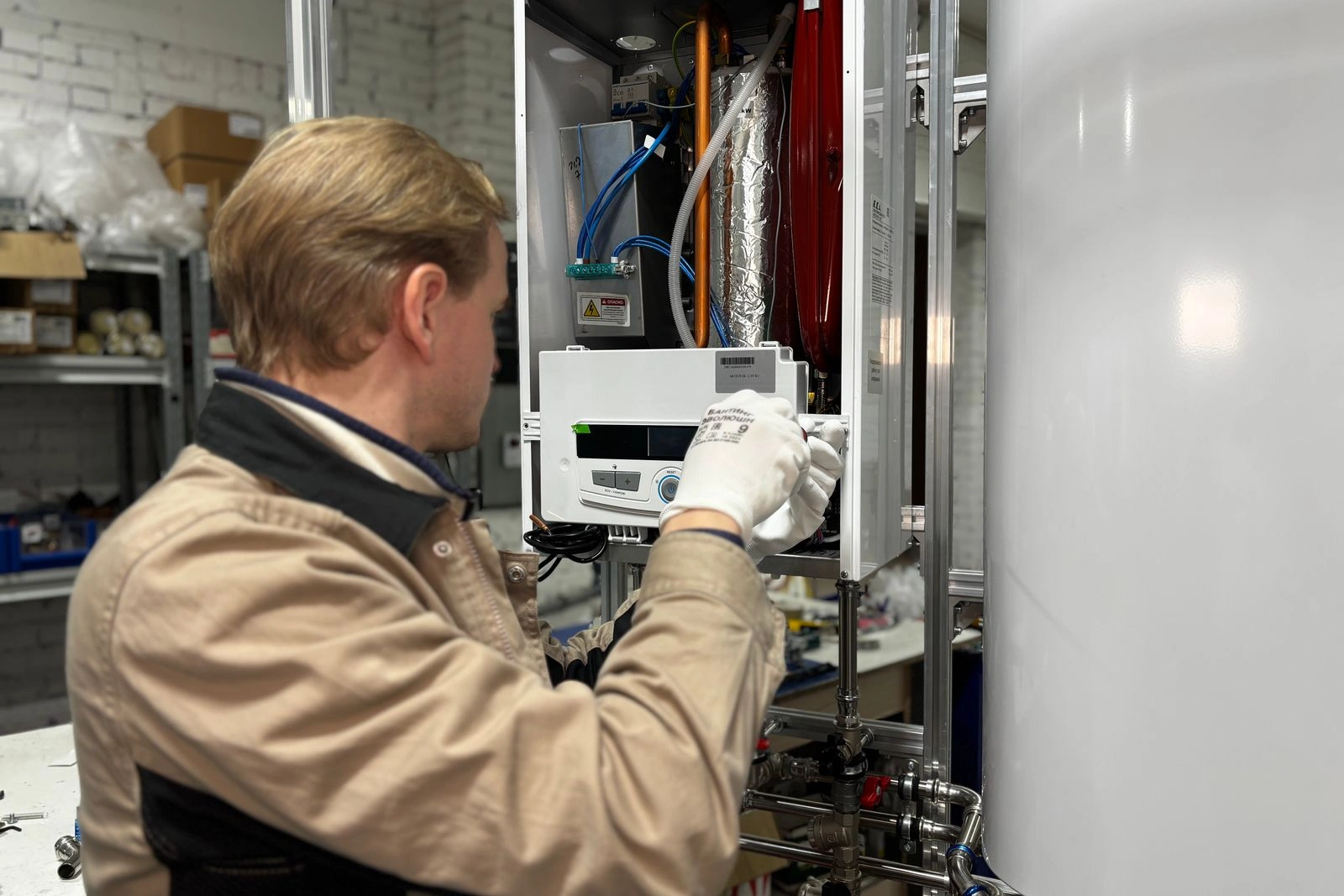
If your water heater is leaking, turn off its power or gas and shut off the cold water supply to the tank. Then move belongings out of the water and get the floor and nearby walls dried. A leak from a valve or fitting can often be repaired. A tank leaking from its body has rusted through and has to be replaced.
Key takeaways
- Turn off the gas or the breaker and close the cold water supply valve on top of the tank.
- Condensation is often mistaken for a leak, so confirm the source first.
- Tank water heaters typically last 10 to 15 years, according to the U.S. Department of Energy.
- Water from a failed tank is usually clean, so floors and walls can often be dried in place if it’s caught quickly.
What to do right now
- Turn off the energy. For a gas heater, turn the gas control to off or pilot following the label on the unit. For electric, switch off its breaker. Don’t touch the panel if you are standing in water.
- Shut off the water. Turn the cold water supply valve on top of the tank to off. If you can’t reach it, shut off the main water to the house.
- Watch for hot water. Water in the tank and leaking from it can scald. The CPSC notes water at 140°F can cause a third-degree burn in about six seconds.
- Keep the water from spreading. Move boxes, rugs and stored items out of the wet area and away from the door into the house.
- Take photos of the heater, the leak and the damage for insurance.
- Call a plumber for the heater and a restoration company if water reached drywall, carpet or the house.
Is it a leak or condensation?
Water heater maker A.O. Smith notes condensation is often mistaken for a leak, especially on a gas heater filled with cold water or in humid conditions. Before assuming the tank failed, wipe the heater and pipes dry and watch where water reappears. Also check nearby sources that can drip onto the floor beside the heater, such as a furnace or AC condensate line or a water softener.
Water damage right now?
We answer 24 hours a day, 7 days a week, across Murrieta 92562 and 92563.
Call (951) 364-1418Where water heater leaks come from
Leaking from the top
Usually the cold inlet or hot outlet connections, which can loosen or corrode, or the temperature and pressure relief valve. These are often repairable.
The temperature and pressure relief valve
The T&P valve opens to release excess temperature or pressure. A.O. Smith says T&P leaks are often caused by excessive temperature or pressure, and that a properly sized and charged expansion tank addresses thermal expansion in closed plumbing systems. The valve itself is not designed to handle thermal expansion. A valve that keeps dripping should be checked by a plumber, not capped.
Leaking from the bottom
The drain valve near the bottom can drip if it is loose or worn, which is usually a simple repair. Water running down from a fitting above or from the T&P discharge pipe can also collect at the base. If none of those is the source, the tank itself has likely rusted through.
The tank itself
A.O. Smith notes a cracked or leaking tank usually means replacement. A failed tank can’t be repaired.
What makes water heaters leak
- High water pressure. Under the California Plumbing Code, a pressure regulator is required when pressure exceeds 80 psi, as the City of San Diego explains. Excess pressure strains fittings, valves and the tank.
- Thermal expansion in a closed system without a working expansion tank, which A.O. Smith says the T&P valve is not designed to handle.
- Sediment and hard water. Minerals settle at the bottom of the tank, which is why A.O. Smith lists flushing as routine maintenance.
- Corrosion once the anode rod is used up and the tank starts to rust from the inside.
- Age. Tanks near the end of their 10-to-15-year life fail more often.
Repair or replace?
- Repair: loose or worn fittings, a leaking drain valve, a T&P valve or discharge problem caused by pressure that a plumber can correct.
- Replace: a leaking tank body, heavy rust around the base or seams, or a heater near or past its expected life. The U.S. Department of Energy puts storage tank water heaters at 10 to 15 years.
How to drain a leaking water heater
Draining empties the tank so it stops leaking and can be removed. Follow the manufacturer’s instructions; the usual steps are:
- Turn off the gas or power and close the cold water supply valve.
- Let the water cool. Tank water can scald.
- Attach a garden hose to the drain valve and run it to a floor drain or outside.
- Open a hot water faucet in the house to let air in.
- Open the drain valve and let the tank empty.
If the drain valve is clogged with sediment or you are unsure about any step, leave it to a plumber.
Warning signs of a failing water heater
- Rust on the tank, the fittings or in the hot water
- Moisture or small puddles around the base
- Rumbling or popping from sediment in the tank
- An age near or past 10 to 15 years
California water heater rules
California Health and Safety Code section 19211 requires new, replacement and existing residential water heaters to be braced, anchored or strapped to resist falling or moving in an earthquake. Sellers have to certify in writing that the heater is strapped.
Building department guidance based on the California Plumbing Code places straps within the upper and lower thirds of the tank and requires the T&P discharge pipe to run to an approved location. In garages, gas water heaters must have their burners at least 18 inches above the floor unless the unit is listed as flammable-vapor-ignition-resistant, and the heater must be protected from vehicle damage. A drain pan is required where a leak could cause damage, such as in an attic or on an upper floor. Check with the City of Murrieta’s building department for requirements on your installation.
How to prevent leaks
- Flush sediment from the tank. A.O. Smith describes annual flushing as typical maintenance, and the City of Anaheim suggests draining one to two gallons every six months, more often with hard water.
- Check the anode rod and replace it when it is worn. A.O. Smith lists anode checks and replacement as typical maintenance.
- Operate the T&P valve lever once a year. Valve maker Watts also calls for a licensed contractor to inspect the valve at least once every three years.
- Have your water pressure checked. If it is above 80 psi, a pressure regulator is required.
- Set the temperature to 120°F. The CPSC recommends it to prevent scalds.
- Keep the area around the heater clear so a small leak is noticed early.
Dealing with the water damage
Water from a water heater is usually clean, so carpet, baseboards and drywall can often be dried in place when drying starts quickly. EPA advises drying water-damaged areas within 24 to 48 hours to prevent mold, and notes porous materials such as carpet may have to be thrown away if they become moldy. When the heater is in the garage, check the wall shared with the house and the floor on the other side of the door, where water often travels unseen.
Water heater leaks in Murrieta homes
In Murrieta
Most of Murrieta’s housing is from the last few decades: about 48 percent of homes were built from 2000 to 2009 and about 22 percent in the 1990s, according to housing data compiled by the Southern California Association of Governments. With a typical tank life of 10 to 15 years, many of those homes have already replaced their original heater or soon will. Garage installations are common, so a failed tank often spreads water across the garage slab and under the door into the house. EMWD’s water quality report rates its water from moderately hard to very hard depending on the source, so sediment builds up faster in homes it serves; check your own provider’s report.
Water heater leak FAQs
Why is my water heater leaking from the bottom?
It can be the drain valve, water running down from a fitting above, or the T&P discharge. If none of those is the source, the tank has likely rusted through and needs replacing.
Is a leaking water heater dangerous?
It can be. Hot water can scald, water near outlets and panels is a shock risk, and a gas heater sitting in water should be shut off. Turn off the energy source and call a plumber.
Can I still use water if the water heater is leaking?
Yes, once you close the cold supply valve on top of the heater, the rest of the house keeps cold water. You won’t have hot water until it is repaired. If you had to close the main valve, the whole house is off.
How long will a water heater last once it starts leaking?
There is no reliable estimate. A leaking tank usually gets worse, and A.O. Smith advises against continuing to use a leaking heater, so plan to repair or replace it right away.
How long do water heaters last?
The U.S. Department of Energy says tank water heaters last 10 to 15 years.
Does insurance cover water heater leaks?
The California Department of Insurance notes insurance typically pays to fix the resulting water damage to walls and floors, while the water heater itself is a repair or warranty item.
Water heater flooded the garage?
We extract the water and dry the garage and house. Call any time, day or night.
Call (951) 364-1418